

By Jemima Rose, Healing Diets Coach graduate and Naturopathy Student
Meanwhile the wild geese, high in the clean blue air, are heading home again. Whoever you are, no matter how lonely, the world offers itself to your imagination, calls to you like the wild geese, harsh and exciting over and over announcing your placein the family of things.”
-Mary Oliver
Autumn Delights: Sea Buckthorn

Sea Buckthorn / Elaeagnus rhamnoides
Habitat: Coast lines, sandy hills and dunes
Month to Forage: Late summer to early spring
Parts used: Fruit (leaves are sometimes picked and dried for tea)
This beautiful, golden orange fruit can be seen decorating dunes along the coast line. We have found these at a local beach, along with sea beets, too! The juice of sea buckthorn can be compared to the colour of battery acid, although that doesn’t do it justice, so I like to imagine instead that I am drinking a sunshine elixir.
Health Properties of Sea Buckthorn:
I have never tasted such a delicious and timely vitamin C boost. Sea buckthorn has over 10 times the amount of vitamin C a lemon does.
Of course its orange/yellow colour means it is high in beta-carotene, along with vitamin E and other antioxidants.
Recognised in Tibetan medicine for millennia, modern medicine has only recently noted that sea buckthorn has cardioprotective properties. In Tibet, the plant was employed to address various ailments such as stomachaches, lung disorders, colds, coughs, fever, inflammation, abscesses, toxicity, tumours, constipation, and gynaecological issues. It’s noteworthy that many of these traditional uses are currently undergoing scientific investigation.
It is a tonic for vitality and exhaustion, providing a slightly stimulating effect due to its high amounts of vitamin C and should therefore be consumed in the day.
How We Enjoy Sea Buckthorn:
Make this winter warmer by combining the juice of the sea buckthorn berries with apple juice, cinamon, nutmeg, and a squeeze of lemon. Warm on a low heat and then relish the ultimate autumn (and winter) boost! You can also freeze these berries and enjoy them in smoothies, juices, as teas, to dry and add as a powder – super versatile.
Watch out when you pick them, as the bushes are filled with thorns. We will sometimes prune the trees, taking home small branches with clusters of berries that then go into the freezer, and can more easily be broken off.
Autumn Delights: Rosehips & Hawthorn Berries

Rosehips and Hawthorn Berries / Rosa and Crataegus monogyma
Parts used: Fruiting body
Habitat: Hedgerows in fields, gardens and parks
Months to forage: September nad October
I have an affinity with roses. Perhaps because Rose is my middle name, or maybe due to the exquisite beauty this plant radiates. Rose petals are wonderful, yet rosehips are also a treat!
This is when you will find me on ‘wonder’ walks, scouring the hedgerows for glimpses of red – knowing that more often than not, where I find rosehips, I will also find blackberries, hawthorn berries and sloes! All of which we enjoy – ‘hip and haw’ ketchup is one of our go-to recipes.
Health Properties of Rosehips and Hawthorn Berries:
Both the rose and the hawthorn connect to the heart, and perhaps that is part of why I love them so much.
Rose helps to restore vitality and joy – if you’ve ever stopped to smell the roses, you will understand this. Rose is antiviral, anti-inflammatory, anti-depressant, and the hips in particular are rich in vitamin C, and can be prescribed to treat colds and sore throats. [9]
Hawthorn, often rich in vitamin C, is often prescribed to strengthen the heart and help regulate the heartbeat. It can also help to balance blood pressure, treat insomnia and stress and ease breathlessness. [9]
Both the hip and haw, abundant in Autumn, teach us that what we need to stay well through this season and the next, is contained in these perfect fruits of nature – nature is beautifully wise.
How We Enjoy Hips and Haws:
Collecting hips and haws takes time, then there is the preparation that is also a slow process. If we are making ketchup along with haw berries, then both go into the pot to boil and reduce down. It is then a case of filtering out the inedible or undesirable parts of these plants – rosehips have tiny, fine hairs inside that can be irritating to the digestive tract. So if you are drying the hips for tea, they need to either be scooped out before you dry, or they need to be carefully filtered out later.
Autumn Delights: Ceps

Cep / Porcini / Penny Bun / Boletus edulis
Habitat: Beech, oak, birch, conifer woodlands
Month to harvest: July to October
The first time we found a large gathering of ceps, I may have uttered the words, “Bingo, f***ing bingo!” Excuse my french! But the excitement was just too much!
Amusingly, my family (children included) now repeat this phrase when we are reliving this wonderful memory. Never to be forgotten.
My eyes had been drawn to a shape that looked unmistakingly like a cep. As I ducked under the bracken for a closer inspection and realised that it was indeed a beautiful specimen and ripe for the picking, I shouted ‘Bingo!” so that my family could share my joy.
But then, as I looked around, I saw a carpet of beautiful ceps, standing tall and proud. And this is when the expletive escaped my mouth! We joyfully collected a basket full, leaving the elderly specimens to spread their spores, and their grandchildren to grow and be enjoyed by the forest and its inhabitants.
I also vividly remember the time I found my first cep – and the next time we visited the forest, I was able to go straight to the tree under which it grew.
Another plus to the porcini is that it is very recognisable. There are perhaps one or two other boletus species you could confuse it with, so as always, trip check your ID.
Health Properties of Porcini / Cep:
The porcini is considered a prime medicinal mushroom, in most part due to its incredibly high content of beta-glucans. The cap contains around 17%, but the stem contains 57%! So don’t discard the stem!
Some lab studies have found that porcini show the ability to kill cancer cells, also fighting free radicals in the body due to their high antioxidant content. [5]
How We Enjoy Porcini / Cep:
If we find lots of cep in Autumn, which we often do in the pine woodland nearby, then we dry them and enjoy them throughout the year in stews and soups.
Fresh, we gratefully relish them in many savoury dishes, from lasagna, to soups, rice meals and more. Ensure to use both the cap and the stem!
Autumn Delights: Parasol
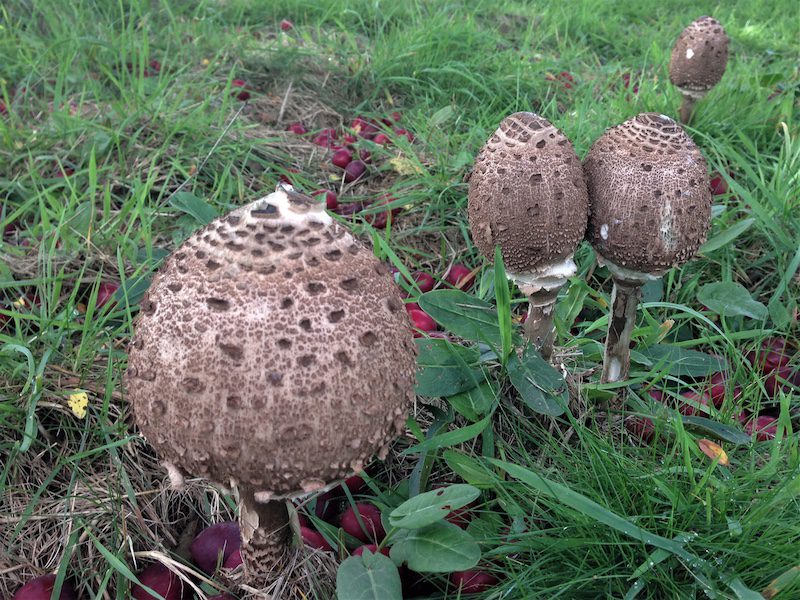
Parasol / Macrolepiota procera
Habitat: Open hillsides, meadows, parks
Month to forage: Late summer through to early autumn
Parasols are joyful! They can grow so huge (look at my daughter’s gleeful expression at having found the biggest yet!) – and resemble, well, parasols! You can spot parasols from afar. The first time we discovered these, my children were skipping from one to another with such excited smiles.
The first parasol of the season is a wonderful feeling. Some years, they don’t seem to flush as well, because, much like all fungi, their growth and success is dependent on the weather.
They favour a big downpour of rain followed by warmer, sunnier skies. One early October morning, under a bright blue sky, after a particularly wet week, I hiked up to the local hill and couldn’t believe how many parasols were starting to pop up.
Health Properties and Cautions for the Parasol:
Parasol mushrooms, known for drawing minerals from the soil, like iron, calcium, potassium, and zinc, show potential medicinal properties. In vitro studies suggest effectiveness against certain cancer cells and moderate antioxidant/antimicrobial activity. However, the high cadmium content raises safety concerns, and there’s a lack of testing on living subjects. While promising, it’s premature to confirm its actual medicinal value. [10]
Another risk is confusing them with the shaggy parasol, which is considered edible, but may cause gastric upset. Also, when very young, a parasol can resemble the toxic amanita species, though this is rare. And clearly, considering all this, we have found great joy in the parasol.
How We Enjoy Parsol:
We cook most of our mushrooms in the same way – by lightly frying in a drizzle of olive oil. However, with parasols, chicken of the woods and puffballs, we will also make them into schnitzels, by covering them in homemade bread crumbs – AND – on occasion, we have made temperature parasols – so good!
“When you follow a wild path you are called ever deeper.” – Claire Patterson Conrad.