

Urtica Dioica
By Emma Johns, Master Herbalist Student
My Growing Love for Nettles and Foraging
I have been foraging now for the last three years or so, and I started with nettles. My respect for this considered ‘weed’ has grown each time, and I love experimenting with recipes shared by friends and online. I enjoy immensely the process of foraging for nettles also, as it is so perfectly timed with the welcoming of Spring and I can delight in being out in the beauty. At the end of this blog, I will include two of my favourites, simplest nettle leaf recipes- one a soup, and the other a tea. My favourite kind of food and drink really!
Cultures celebrating self-healing and foraging for natural food have prized this plant for thousands of years. In England nettle has been part of many a folklore, used as protection against lightning in past times, a plant in the spirit world which promoted healing, and as a symbol of fertility- nettle is said to have fertility-promoting potency, especially for men. In Ancient Britain, both the Romans and the Saxons applied the plant in their Materia Medica regularly, the Romans using it to treat rheumatism (the seeds are used in the treatment of arthritis today) and the Saxons in folk remedies to ward off evil spirits, which they drew connections to ailments.
When I first began foraging for nettles, many of my friends from Eastern Europe were encouraging me with all the harvests they came back with. It really impressed me that in countries like Hungary and Romania, many people still have such an ancient connection with wild foods and understand their medicinal benefits.
Learning more about nettles I realise how much of this connection is to be revived here in Britain. Perhaps it is because of our over-dependence on the NHS and modern-day drugs which has somewhat severed our traditions. I have a minority of friends in Britain who regularly forage, but it often feels like a small number. But I see this is growing! And where I live in Cambridge, I am beginning to see some fellow foragers walking around with bags in the local woods, seeking and delighting in what Mother Nature has to offer.
Medicinal Properties
Stinging Nettle is a superfood which is abundant in vitamins, minerals, fatty acids and carotenoids. It is full of chlorophyll and the minerals: iron; potassium; nitrogen; zinc; magnesium and copper. It is also high in Vitamins A, B1, B5, C, D, E, and K. This abundance of nutrients means the nettle is an amazing tonic and nourisher. Its main actions are as a cleanser and astringent. The plant helps the body to detoxify by acting as a diuretic, supporting elimination through the urine. It is known to help support prostate health because of this action also. It also works wonders for the skin, particularly in preventing and treating conditions such as eczema. Its astringent action helps to stem the flow of blood; hence why it has traditionally been used with nose bleeds and heavy menstrual flow.
All parts of the plant can be used which include the roots, seeds, and aerial parts of the nettle. The roots are used for its diuretic properties; the seeds are hepatoprotective and also used in the treatment of joint pain and inflammation; and the aerial parts (including the stem and leaves) are used as a super tonic and cleanser. I feel great after a dinner of nettles or a nettle tea…this plant is truly healing as a food. For the purpose of this blog, I will be exploring what you can do with nettle leaves only.
How to Harvest

Nettles can be harvested all the way through from January to December which makes them hugely accessible; the only thing to watch out for is to forage and harvest nettles which don’t have flowering tops as when they are in bloom, they have a laxative action and contain cystoliths which cause upset to the urinary tract. This can be navigated by cutting back a patch of flowering nettles somewhere you will return, and then harvesting the fresh tops which will consequently appear.
When foraging I tend to go to the bottom of my garden where we have left a large patch for them to grow (the butterflies thrive on them and I want to welcome our winged friends also), as well as to the local woodland in our city. Coldham’s Common in Cambridge is a beautiful area of land home to much wildlife and flora, and I absolutely love foraging here for hawthorn, rosehip, blackberries and of course nettles. There are some pretty open areas, but mostly these medicinal plants grow abundantly in amongst the untamed bushes and woods which scatter throughout the common.
For nettles I like to go deep into the woodland where dogwalkers are less likely to have walked (avoiding any spoils and animal pee and poop!), and it is also a bonus that the Common has no traffic, so there is less possibility of pollution which would affect the plants. I often couple foraging in the Common with taking our little corgi Goldie for a walk, leaving him to sniff around whilst I go off path and climb into a space of nettles. He really loves the wild too and is equally occupied when I am focusing on foraging!

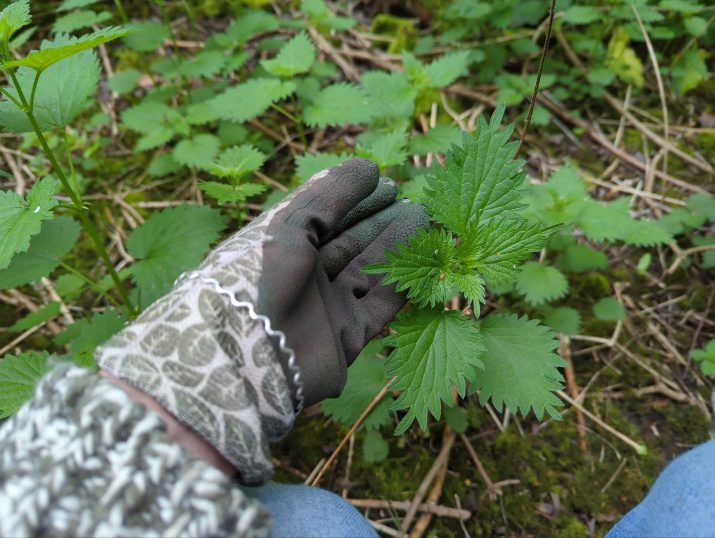
The things to bring with you foraging for nettles are:
· some snippers such as a pair of scissors or secateurs
· gloves to protect your hands
· a sizeable bag
· a long-sleeved top as well as trousers
I know there a good number of foragers and gardeners who like to express gratitude to the plants they are about to harvest, and I really love this practice. I have my own way, and that is to let the plants know that I am here and thankful for their existence. And then whilst I harvest, I sing mantra. My favourite mantra is Wahe Guru, which literally translates from Punjabi to English as ‘Wow Guru’ or ‘Wonderful Lord’. I really feel this to be so true, like a child experiencing something new for the first time with excitement- that is how I feel when I’m foraging…like WOW! there is so much abundance, thank you!
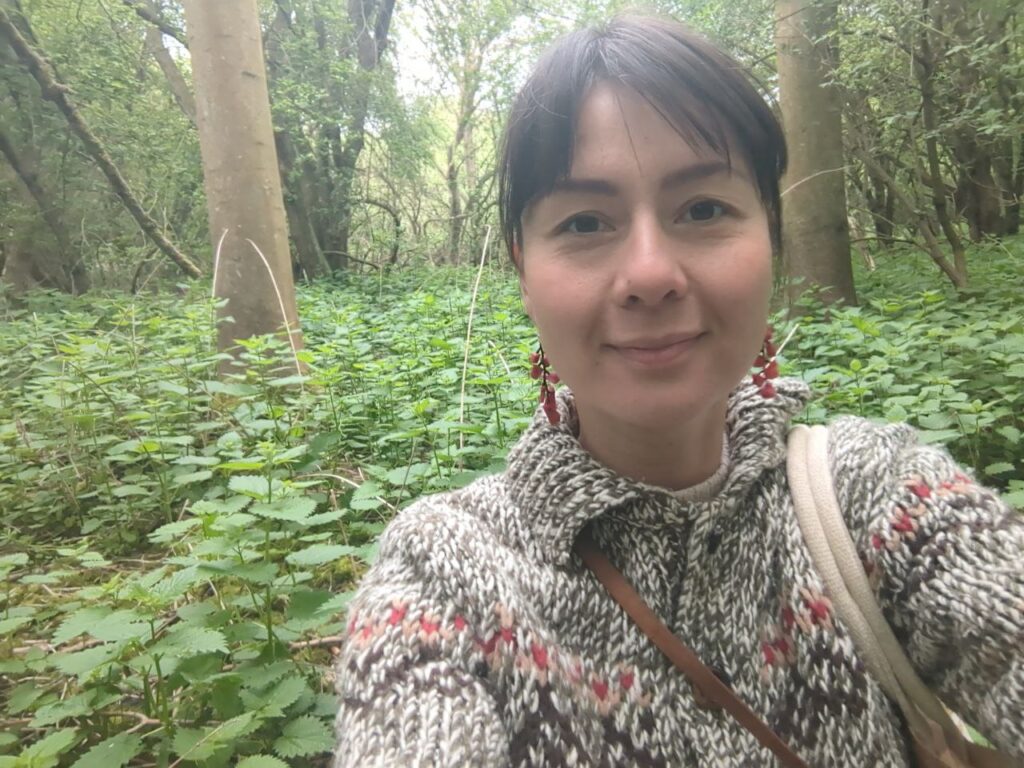
With nettles, I snip off the tops from the top most quarter. Remember not to harvest from a nettle which is flowering. I like to gather from plants which haven’t grown to their peak height yet (1.5m); yet also not from ones so close to the ground that they are likely to have come into contact with wildlife easily, though that can be challenging to guarantee. The plants I forage get washed really thoroughly anyway, so I don’t focus too much on what the likelihood is that they have been contaminated as that takes the charm away from it. I am foraging in the wild after all! I recommend using your senses and intuition when choosing which plant to harvest from, you can’t go wrong if you listen to your instincts! Obviously if the leaves look spoiled in anyway don’t bother.
I also try not to harvest too much from one area and spread my search and gather from other clusters too. This is because the good practice of the forager is to always take what you need without making a significant impact on the plant and area you are harvesting from. Firstly, the plant needs to be able to regenerate and secondly, there are other foragers (including insects and animals) who rely on the plant for food. Oh, and always make sure you know for sure that is the nettle you are foraging! If you are not sure, don’t pick it. Stinging nettles are pretty simple to identify but just in case, make sure you familiarise yourself with lots of references and pictures. I’m sure most of us have been stung a good few times, so you are probably well- acquainted! But it’s always important you know for sure!
Once I’ve harvested the amount I feel is good to make some recipes, I go home and wash the nettles in some white vinegar, lemon and water and let them soak for at least a couple of hours. Then I change the water to just water, and wash several times before spinning. Make sure to wash thoroughly to eliminate all doubt- you don’t want that kind of anxiety and energy eating it. You want your forage to taste good without worrying if it’s covered in poop or got bugs in it!
To dry, you can either hang your nettles in bunches using string to dry slowly, or spread them out in a dehydrator or oven on a very low setting. I use a dehydrator which I’ve had for a year now and that I love using for other recipes. I either dry the nettles for tea and for future cooking, or leave them as they are after washing and store them in the fridge ready to make soup as soon as possible.
Heartwarming Nettle Soup
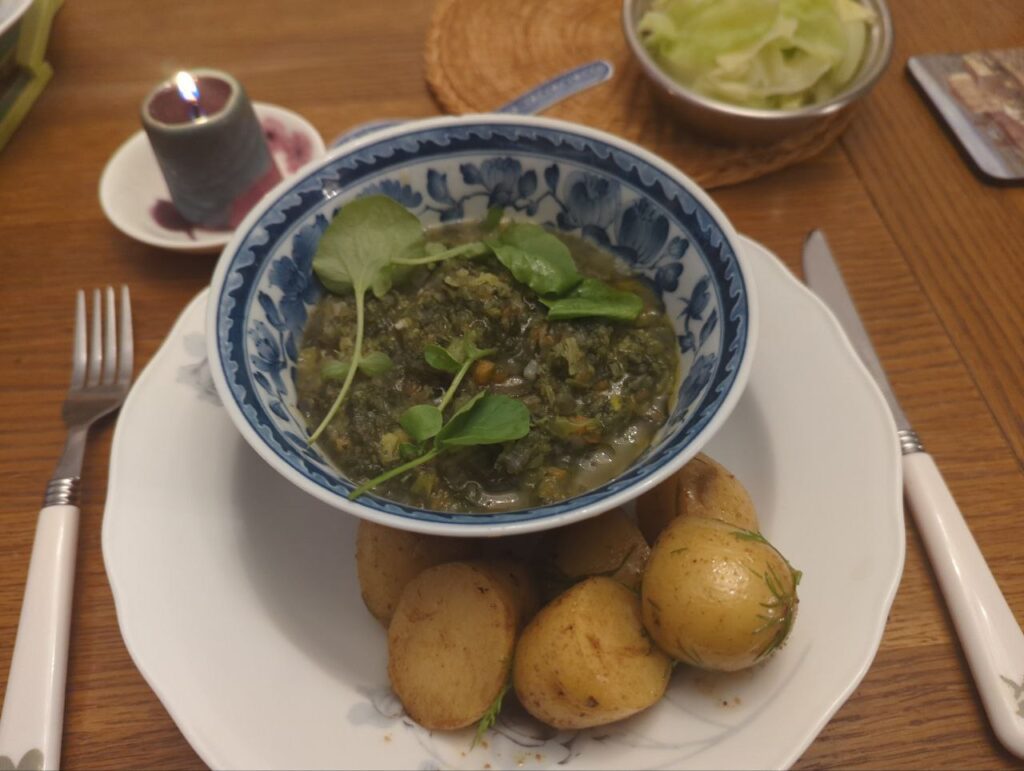
This soup is so delicious and nutritious. Nettles have such a distinct flavour and when cooked they have the same texture and look as spinach. I like to eat this soup with some boiled new potatoes on the side rather than bread. Serves 4-5 people and takes about 30 minutes, really simple!
Ingredients for Heartwarming Nettle Soup Recipe:
- ½ a bag of nettles, washed and drained (about 200g)
- 1 large red onion, skinned and diced
- 3 garlic cloves
- 2 Leeks, chopped
- 2 carrots, peeled and chopped
- 2 sticks of celery, chopped
- 1.5 litres of vegetable stock (I use kalo stock cubes)
- 1 teaspoon of coconut oil
- ¼ teaspoon of cumin
- Celtic sea salt or Himalayan salt to taste
- Handful of watercress/peashoots to garnish
Method
1. First, boil the carrots and celery in the vegetable stock. Once up to boil, simmer on a lower heat for around 15 minutes.
2. Whilst the stock, carrots and celery are simmering, use the coconut oil to fry the red onion, leeks and nettles in a large frying pan or saucepan for about 3-4 minutes.
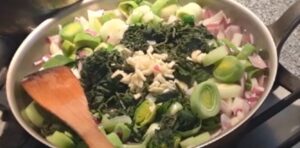
3. Next, mix altogether in a large saucepan and then blend on a high-speed in a blender to your preferred consistency. Put the cumin in with the blend.
4. Serve up in bowls with a few watercress stems or pea shoots to garnish and decoration.
For the new potatoes as a side, I like to boil up enough for the dinner and then wait for them to cool before mixing in a large salad bowl with some: olive oil, balsamic vinegar, Italian mixed dried herbs (oregano, thyme, rosemary, marjoram), a sprinkle of sea salt and some shredded fresh dill if it is in season. Bon Appetit!
Nettle Refresher Tea
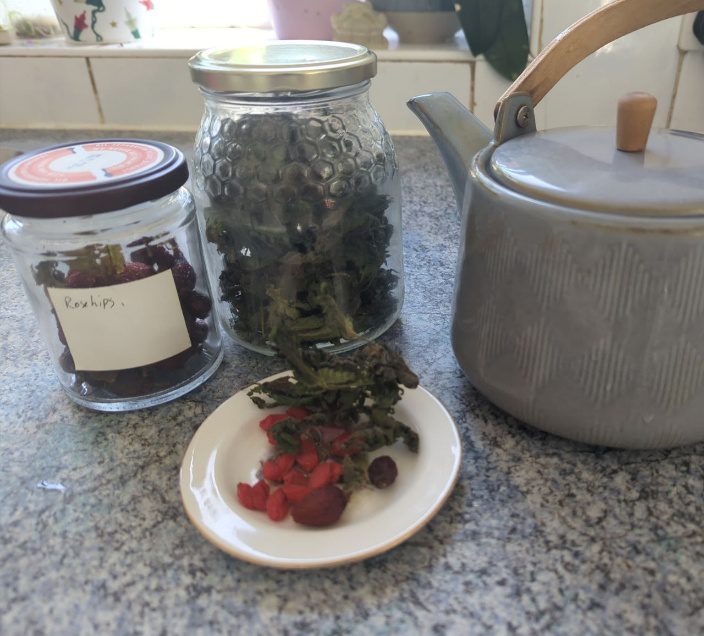
This is a really wonderful, refreshing tea that can be drunk either hot or chilled. The rosehips in this recipe I forage in the autumn and dry them and store them away. Rosehips are full of Vitamin C, protect cellular health and support heart health, Dried, they have a mild rose-like aroma, which I feel compliment the earthy nettle taste in tea.
Goji berries are just a favourite of mine in tea. They (like nettle and rosehips) are also a superfood, and have numerous health benefits including being immune-protective, heart supportive, anti-carcinogenic and great for neurological and reproductive health.
I spontaneously made up this recipe when I was living in Portugal and was sifting through my cupboards of dried goodies to see what I could make on a very hot day. My friends and I were so pleasantly surprised by this tea, it tastes so nice. You don’t have to include goji berries if you can’t get hold of nice ones. But if you can, it is such a treat.
I’ve also added some red raspberry leaf in before which was divine!
The amount shown in the pictures is for a teapot for one. This teapot has a strainer inside it and is very easy to use, but you can use a handheld strainer after brewing.
For one person take:
· 1 tablespoon of dried nettles
· 2 dried rosehips
· 3 dried goji berries
Method
Boil water (enough for one) and mix with ingredients in a teapot or small saucepan. Let it brew for at least 5 minutes for the depth of flavour to fully come out. Enjoy with a nice book or sitting outside somewhere.
I hope in this blog I have managed to convey to you just how wonderful nettles are. The information I’ve included is just a fraction of the knowledge on this potent plant and medicine, and there are countless recipes out there too. Enjoy foraging!